
BUILDING THE MISSING CAPABILITY
THE PURPOSE
Find what is true.
Preserve it.
Make it visible.
Make it auditable.
Make it harder to capture.
Build systems in which evidence and reasoning remain available for anyone to inspect, challenge, correct, and expand.
No one gets to own your relationship with reality.
THE PROBLEM
Civilization has never reliably solved one of its oldest problems:
Concentrated power repeatedly becomes exploitative, the systems meant to correct it repeatedly fail, and ordinary people repeatedly realize how bad things have become only after enormous damage has already been done.
This is not an occasional glitch.
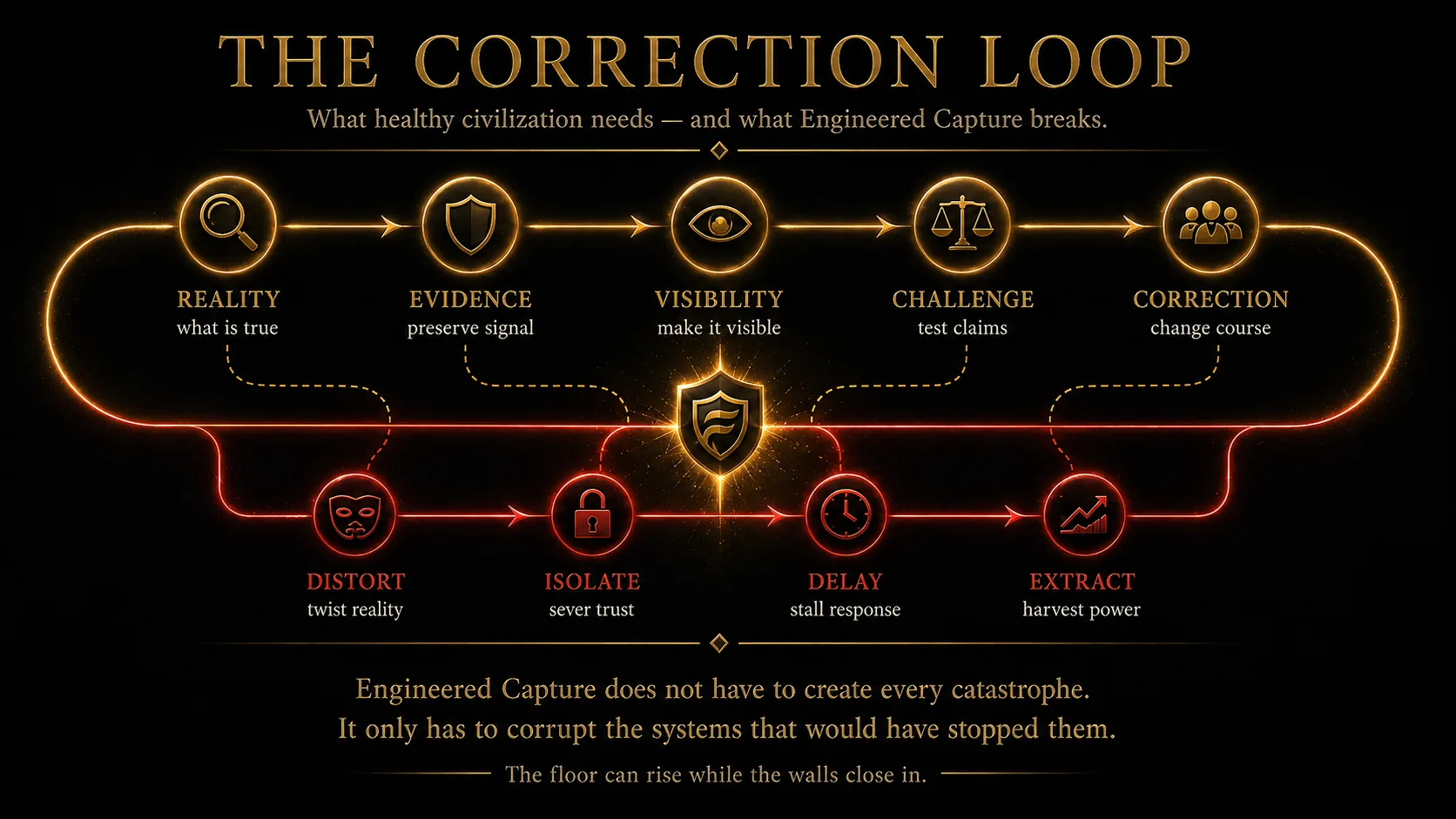
Engineered Capture is a recurring, first-order mechanism by which concentrated power turns dependency and chokepoints into extraction, protects that extraction through perception management and impaired correction, and can persist even as societies become materially richer.
The floor can rise while the walls close in.
ONE THING BEFORE WE GO FURTHER
This is not an argument for despair, revolution, or tearing civilization down.
The way through may be far smaller—and far more practical—than the problem suggests.
This is not an argument against wealth, markets, ownership, ambition, or extraordinary success—and no one is being asked to apologize for succeeding inside the world they inherited.
The opportunity is to make success more durable—and create far more of it—not punish the people who have already achieved it.
Almost everything worth preserving can be preserved. And the first move is surprisingly simple.
But to understand why it could work, we first have to see what is preventing correction now.
AT A GLANCE
THE WHOLE ARGUMENT IN FIVE MINUTES
01
THE PROBLEM WITH PROBLEMS
Civilization repeatedly creates systems that capture chokepoints, privatize gains, externalize costs, normalize harm, and turn human beings into extractable inputs.
Now we are giving captured systems technologies powerful enough to identify, isolate, and dismantle resistance before it can organize—turning recurring exploitation into potentially irreversible lock-in.
The most dangerous part may be how normal it can still look while it happens.
02
PARADIGM BLINDNESS
THE UGLIEST LAW OF BELIEF
People protect status, identity, and belonging before they protect the truth.
When seeing clearly threatens who we are, where we belong, or our need to believe we are good people, the cost of seeing can become greater than our commitment to our own stated principles.
Avoidance rarely feels like avoidance. It feels like finding a perfectly reasonable reason the problem isn’t important, isn’t proven, isn’t our responsibility, or simply isn’t worth engaging.
The facts are permitted. The pattern is forbidden.
03
THE MISSING CONDITION
THE THRESHOLD IS NOT TRUTH. IT IS INESCAPABILITY.
Knowing ≠ Believing ≠ Acting.
People and societies can know something is true for years without allowing it to meaningfully change their behavior. We tend to act only when the consequences become too immediate, too personal, or too undeniable to keep explaining away.
By then, the cost of refusing correction may already have been paid—and the meaningful intervention window may already be gone.
04
THE GOOD NEWS
WE DO NOT HAVE TO FIX HUMANITY.
We do not need universal agreement, moral perfection, or eight billion people to wake up at once.
The intelligence already exists. The people already exist. The solutions already exist in pieces. What is missing is enough permission, protection, and convergence for the right people to see clearly, speak honestly, and act before the window closes.
And we do not have to eliminate every failure. Even modest reductions in the most wasteful forms of extraction, conflict, and managed scarcity could release enormous amounts of money, time, intelligence, and human potential back into creation.
Make the worst failure loops less rewarding, easier to see, and easier to interrupt—then let the gains compound in the other direction.
05
THE THIRD PILLAR
CORRUPTION IS NOT A SIDE EFFECT.
Most explanations of civilizational failure stop at two forces:
SYSTEMS DRIFT.
HUMAN NATURE.
But there is a third.
Organized corruption and predation are themselves a first-order causal force—and often a key mechanism shaping, amplifying, and driving the other two.
When that force reaches the institutions meant to expose abuse, restrain power, protect dissent, and punish criminality, the immune system can begin working against the host—protecting the disease itself: organized predation, corruption, and domination, until the damage becomes catastrophic.
06
THE FIRST EXPERIMENT
ONE SMALL ROOM IS ENOUGH.
This does not begin with millions of people, a new government, or a global movement. It can begin with four people in a room.
The right people already understand different pieces of the problem. Put enough of them together, give them permission to speak honestly, and something important changes: what felt impossible becomes discussable, mappable, then actionable.
Thought leaders do not merely spread ideas. They grant permission. A handful of respected people willing to look clearly, disagree honestly, and try something better can give thousands—and eventually millions—permission to do the same.
The first room is not the solution. It is proof that another way is possible.
07
THE END OF THE WORLD
THE GAME DIDN’T CHANGE. THE CONSEQUENCES DID.
Human beings are still playing the same ancient games of rivalry, domination, extraction, fear, and control. The difference is that we are now handing those games technologies with civilization-scale consequences.
New power amplifies the system that receives it.
A system built around extraction becomes better at extraction.
A system built around control becomes better at control.
A system built around dependency becomes better at making dependency permanent.
But a system built around human agency can scale judgment, experimentation, discovery, creation, and the ability to correct itself.
The question is not how powerful our technology becomes. It is what game we teach that power to win.
08
THE WORLD WE KEEP THROWING AWAY
HUMANITY ISN’T POOR. WE ARE CATASTROPHICALLY INEFFICIENT AT BEING RICH.
We already possess staggering intelligence, technology, capital, productive capacity, and human potential. Then we spend an extraordinary share of it fighting, defending, manipulating, extracting, duplicating, policing, repairing, and recovering from damage we create for one another.
We keep solving scarcity technologically while recreating it strategically.
The hidden cost is not just wasted money. It is the civilization that never gets built—the discoveries, lives, possibilities, and futures consumed by games that make almost everyone poorer, less safe, and less free.
The Golden Age may require far less invention than we think. It may begin by simply using less of the power we already possess against ourselves.
START HERE
SEE THE PATTERN. FOLLOW THE ARGUMENT.
The short version ends here. The deeper case begins with why intelligent people can possess the facts—and still fail to see what those facts mean.