
THE END OF THE WORLD
Somewhere between dead matter and a galaxy-spanning civilization, something may prevent most life from making it through.
It’s called The Great Filter.
One candidate is technological self-destruction: intelligent species become powerful enough to destroy themselves before they become wise enough not to.
If that is one of the filters, it would probably look a lot like this moment in history.
For four billion years, evolution rewarded organisms for acquiring more power.
More territory. More resources. Better weapons. Greater control.
That strategy worked extraordinarily well.
Until one species acquired enough power that one push of a button could set off a chain reaction capable of destroying most of the world.
We may have reached the point where survival depends on becoming capable of carrying that power without being ruled by the impulses that acquired it.
Civilizations driven to power through rivalry and violence may simply be unable to stop before the machinery that made them powerful becomes self-terminating.
And if this is the filter, the silence of the universe may be telling us something.

TERMINAL RIVALRY
For most of human history, competition for power was brutal—but survivable.
Win the war. Capture the resource. Build the better weapon. Outmaneuver the rival.
Then the available power crosses a threshold.
The game doesn’t change. The consequences do.
At some point, the winning strategy becomes suicidal.
What isn’t speculation is the machinery already sitting around us.
Nuclear weapons. Penetrated infrastructure. Billions of people mapped, profiled, predicted and targeted. AI persuasion. Autonomous weapons. Cyber-physical attacks. Directed energy. AI-assisted biological design.
And underneath all of it are the same frightened, ambitious, tribal, status-seeking, occasionally brilliant, occasionally monstrous primates that built the last few thousand years of history.
You don’t have to know what ends the big show to realize we’re standing in a gasoline warehouse full of matches, bad incentives, and people who still think they can win the fire.
THE WORLD CAN END. REALLY.
For most of human history, collapse had limits.
A kingdom fell. An empire broke apart. Millions died. Somebody eventually rebuilt.
Then industrial civilization changed the scale.
World War I industrialized slaughter. World War II mechanized it, added strategic bombing, genocide—and ended with a single weapon capable of erasing a city.
Seventeen years later, two nuclear powers came frighteningly close to starting a war that could have devastated civilization before the conventional fighting even began.
We crossed a line.
Human beings were no longer merely capable of destroying civilizations.
We had become capable of destroying civilization itself.
And now the major powers are drifting back into rivalry as though the last round didn’t nearly kill us.
Some people still treat an extinction-level event as impossible—as though humanity, for all its chaos, will somehow always pull through.
That isn’t hope. It’s denial.
The universe has never promised us another round.
YOU WOULDN’T BELIEVE IT ANYWAY
Tsutomu Yamaguchi survived Hiroshima, made it home to Nagasaki, and told his boss one bomb had destroyed an entire city. His boss rejected the eyewitness account because it violated his model of reality.
Reality resolved the argument by detonating over his head.
Hiroshima was destroyed. The information was accurate. The witness was standing in front of him. The conclusion was still psychologically unavailable until it literally blew up over his head.
THE UNIMAGINABLE REMAINS UNBELIEVABLE UNTIL IT BECOMES UNAVOIDABLE.
THE CHASM
Nuclear weapons are almost comforting in their simplicity.
Big weapon. Big explosion. Everybody understands the problem.
The power coming now is stranger.
Most people “understand” AI, cyberwarfare, synthetic biology, mass surveillance and psychological operations roughly the way they understand how a rocket gets to Mars:
Rocket goes up. Space happens. Mars.
They understand the sentence.
They do not understand the possibility tree hiding inside it.
Cheap, reusable access to space doesn't just mean nicer rockets. It can unlock entire new layers of communication, science, industry, exploration, military power—and eventually human expansion beyond Earth.
Those are some pretty fucking large implications hiding inside “rocket goes up.”
And that's the fun example.
When the words are AI persuasion, synthetic biology, cyber-physical warfare, population-scale surveillance—
the possibility trees get considerably darker.
The gap between what humanity can do and what ordinary people believe humanity can do has become enormous.
Worse—
the gap between what is happening and what can be proven in time to stop it may be even larger.
If people understood what was possible now, they’d be far more worried than they are. The problem is that the next catastrophe may not look like one while it’s still preventable.
So let's zoom out for a second:
World War III isn’t the point. It’s one of a dozen ways this machinery can go catastrophically wrong.
I’m talking about a generative class of problem.
Rivalry. Capture. Extraction. Failed correction. Increasingly powerful technology dropped into the same ancient human game.
The specific disaster can change.
Nuclear war. Biological catastrophe. AI lock-in. Automated totalitarianism. Civilizational collapse.
Different branches. Same tree.
If we never change what keeps generating the problems, we just keep rolling the dice with more powerful tools until eventually one failure doesn’t leave us another round.
I’m using war because it makes that machinery impossible to misunderstand.
WORLD WAR III MAY START TEN YEARS BEFORE ANYONE KNOWS IT HAPPENED
Wealth understands the game instinctively.
When the future is uncertain, you don't bet everything on one outcome. You spread risk. Build leverage. Create redundancies. Secure relationships. Keep liquidity. Preserve an exit.
Countries do the same thing.
THIS IS HOW A WAR CAN BE LOST BEFORE THE SHOOTING STARTS
If the next great-power war comes, the missiles will not necessarily be the beginning.
Long before anybody fires, you map the other country's infrastructure. Steal its secrets. Learn its people. Build dependencies. Gain access. Find pressure points. Position yourself inside systems you may someday need to disrupt.
At the same time, you try to reduce the other side's options.
Make critical industries dependent. Make replacement harder. Make infrastructure more expensive to build. Exploit political fractures. Weaken alliances. Increase uncertainty. Maintain enough ambiguity that every individual event can still be explained as commerce, espionage, crime, activism, incompetence—or coincidence.
You don't need to destroy the other country.
You only need to make it progressively less capable of resisting you.
And ideally, you do it slowly enough that nobody can point to a Tuesday afternoon and say:
There. The war started.
And here’s the trick:
If the war never starts, neither does the defense.
Every individual move stays below the threshold that would justify a full response. A hacked network is espionage. A lost industry is economics. Political manipulation is somebody else’s speech. A compromised institution is corruption. A broken alliance is diplomacy.
Piece by piece, the country gets weaker.
But there is never one clean moment when everybody agrees: We are under attack. Fight back.
Respond too aggressively and you may even look like the aggressor.
So the attacker gets to keep taking pieces off the board while the target is still arguing about whether there is a game.
And here's where the old definition of war starts to break.
There may never be a clear beginning. No declaration. No invasion. Maybe no missiles at all.
The objective isn't necessarily to destroy the other country.
It's to keep reducing its options until resistance stops making sense.
The country can still look completely normal.
Markets open. Elections happen. Flags wave. People go to work.
But underneath that surface, its industries have become dependent. Its infrastructure has become vulnerable. Its alliances are weaker. Its political system is less capable of coordinating. Its population trusts less, fights more, and increasingly cannot agree on what is even happening.
Then a crisis comes.
You may not even need to create it.
You just need to be better positioned when it arrives.
Now every dependency becomes leverage. Every fracture becomes a pressure point. Every buried access becomes an option.
The country can eventually figure out what is happening.
That may not save it.
Because the devastating part isn't that America never notices. It eventually notices.
The danger is that recognition comes after decades of dependencies, penetrations, lost industrial capacity, fractured trust, weakened alliances and accumulated leverage.
The question is how many meaningful choices remain by the time the country realizes it needs them.
Because recognition only matters while there are still moves left.
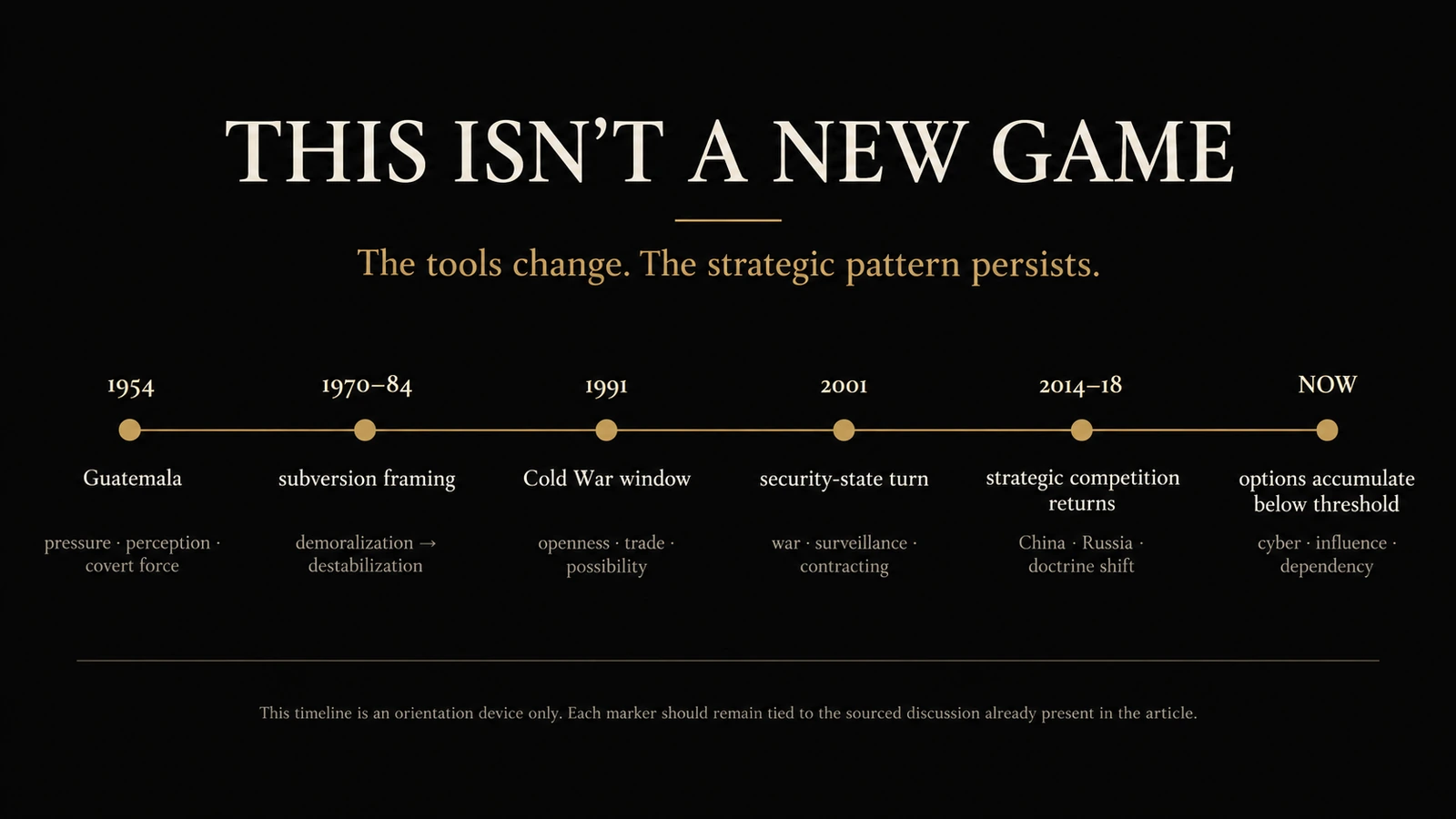
1954 — GUATEMALA
U.S. shows a government can be broken without a conventional invasion. Apply economic pressure. Shape the information environment. Isolate leadership. Manufacture the perception of inevitability. Support internal opposition. Add enough covert force to make collapse look larger than it is.
1970–1984 — THE FORMULA GETS SAID OUT LOUD
Soviet defector Yuri Bezmenov later describes the Cold War version of ideological subversion as a progression:
demoralization → destabilization → crisis → normalization.
And he is talking about a long game.
In Bezmenov’s telling, demoralization alone can take 15–20 years—an entire generation. Destabilization takes another 2–5.
You don’t begin by invading the country.
You weaken its ability to understand itself. Intensify internal conflict. Destabilize the institutions holding it together. Wait for crisis.
Then the solution arrives.
By the time force becomes necessary, much of the work has already been done.
FOR A MOMENT, IT LOOKED LIKE WE MIGHT HAVE LEARNED
The Cold War ends. The Soviet Union collapses. Walls come down. Trade explodes. The internet connects the planet.
America wins without blowing up the world.
For a brief moment, the obvious direction seems to be more openness, more connection, more prosperity—and less reason for great powers to keep playing the same suicidal game.
After spending decades one bad decision away from catastrophe, there is finally a plausible alternative.
It wasn't peace. There were still wars, atrocities, coups and plenty of ugly shit.
But there was a window.
Then, around the turn of the millennium, the old machinery starts spinning up again.
2000 - 2001
Putin consolidates power in Russia. China enters the global trading system and begins its extraordinary rise. 9/11 sends the United States into decades of war while dramatically expanding the security state.
And inside America, another game accelerates too.
Finance discovers increasingly elaborate ways to move risk somewhere else. Corporations discover increasingly elaborate ways to extract more from customers, workers and public systems. Supply chains become extraordinarily efficient—and increasingly dependent.
Nobody has to wake up one morning and decide:
Let's fuck up civilization again.
Everybody just starts playing their part.
And somehow, after coming terrifyingly close to destroying the world twice—
we refreshed the board for round three.
2001 — THE WINDOW SLAMS SHUT
Then 9/11 happens—under circumstances that remain far murkier than the clean story most Americans were given.
Whatever happened around 9/11, we don't need to settle it here. The documented record is enough.
Within weeks, the PATRIOT Act dramatically expands surveillance authorities.
A secret warrantless NSA surveillance program begins outside the ordinary FISA process.
The CIA creates an overseas detention and interrogation system.
Secret prisons. People held outside ordinary judicial process. Torture.
Afghanistan is invaded.
And none of the geopolitical thinking underneath this appears out of nowhere.
Years earlier, The Grand Chessboard had described Eurasia as the central arena of American global power. PNAC's Rebuilding America's Defenses argued for maintaining American military primacy, increasing military capability and sustaining a substantial forward presence abroad—and noted that the transformation it envisioned would likely be slow absent a “catastrophic and catalyzing event” like a new Pearl Harbor.
Then 9/11, then Afghanistan, then Iraq.
Iraq—already an established American target, whose regime change had been official U.S. policy since 1998—is invaded next. The same 1998 law even records Iraq's alleged 1993 attempt to assassinate former President George H.W. Bush.
The public case for war includes claims about weapons of mass destruction and connections to al-Qaeda that a later Senate Intelligence Committee investigation finds were repeatedly unsupported, contradicted, or misrepresented by the intelligence available at the time.
Billions pour into reconstruction and military contracting.
A sole-source contract to restore Iraq's oil infrastructure sends nearly $1.4 billion to Kellogg Brown & Root, a Halliburton subsidiary. Dick Cheney had been Halliburton's CEO until 2000 and continued receiving fixed deferred compensation from the company while serving as vice president.
And hanging over the Pentagon itself:
Its own inspector general had found $2.3 trillion in unsupported accounting entries for fiscal year 1999—entries that lacked the documentation and audit trails required to substantiate them.
Saddam Hussein is removed.
American surveillance power expands dramatically.
The U.S. military footprint across the region deepens.
Military and reconstruction contractors receive billions.
And several objectives that had been openly advocated years before 9/11 are now realities.
So the big picture looks like this:
2001–2010s: China enters the WTO. Offshoring and import dependence accelerate dramatically. The “China Shock” hits American manufacturing. Putin’s Russia accumulates power—while America spends two decades consumed by the War on Terror.
2014–2018: The warning lights become increasingly difficult to dismiss.
2016–2018: Washington increasingly recognizes that it is back in a long-term strategic competition with China and Russia. By 2017–2018, that shift is explicit in U.S. national-security doctrine.
2020: Ray Dalio zooms out, studies the historical rise and decline of great powers, looks at America, China, debt and internal conflict and essentially says:
I've seen this movie before. I don't like where we are in it.
AND NOW WE'RE BACK
Russia is still fighting the largest European war in generations.
Kremlin critics and insiders have developed an almost comically unhealthy relationship with poison, prison cells, open windows and exploding aircraft.
China is applying increasing military pressure around Taiwan while running one of the most sophisticated technological surveillance states in history—and doing a bit of genocide along the way.
And if you want to make the phrase “things could be worse” work a little harder, there is substantial evidence that China has industrialized the harvesting of organs from prisoners of conscience on a scale that may reach well into six figures.
Meanwhile, the United States and Iran are now openly attacking one another around the Strait of Hormuz. Tankers are sailing dark to avoid attack. Roughly a third of Gulf oil exports are still missing from normal flows. Brent crude is back above $100.
Russia is firing drones and missiles into Ukraine. China is preparing for the possibility of a fight over Taiwan. The Middle East is already burning.
And everybody still shows up in suits.
Press conference. Flag. Podium. Carefully selected language. Markets open tomorrow morning.
Same primates. Better tools. Better branding.
You could live through the opening stages of something historically catastrophic and experience most of it as headlines between DoorDash orders.
That is the part I don't think people understand.
THIS IS WHAT BAD LOOKS LIKE
So what does a war look like when nobody has declared one?
Sometimes it looks like Volt Typhoon.
U.S. intelligence agencies say the Chinese state-backed group has already penetrated American communications, energy, transportation and water infrastructure.
Not merely to steal information.
They assess with high confidence that the group is pre-positioning inside those systems so it could disrupt physical operations during a future crisis or conflict.
Water. Electricity. Transportation. Communications.
Not active sabotage.
Held options.
That is the point.
You quietly accumulate the ability to shut things down later while the other side still has to argue about whether anything serious is happening at all.
And cyber access is only one layer.
AT A GLANCE:
China-linked operators pose as Americans and insert themselves into legitimate U.S. political arguments—recently including AI data centers, electricity prices, tariffs and technology policy. OpenAI found likely PRC-origin operators specifically testing narratives against American AI infrastructure while hiding who they were.
X says it uncovered a suspected Chinese bot network containing roughly 200,000 accounts. Only a small fraction were identified posting into the AI/data-center fight—but that distinction almost makes the larger point more interesting:
The infrastructure can exist before the strategically useful argument does.
Meanwhile, U.S. intelligence says China, Russia, Iran and North Korea are increasingly pursuing strategic objectives through coercion and subversion below the threshold of armed conflict—precisely because attribution is difficult, norms are weak and the risk of triggering outright war is lower.
So look at the game again.
demoralization → destabilization → crisis → normalization.
Find the dependency.
Map the infrastructure.
Penetrate the chokepoint.
Steal the technology.
Build the influence network.
Find the real grievance. Amplify it.
Find the political fracture. Push.
Find the supply chain nobody can replace quickly. Turn it into leverage.
And through all of it, maintain enough ambiguity that every individual piece can still be called normal.
Commerce. Espionage. Activism. Crime. Competition. Politics. Bad luck.
Anything except war.
You do not need to manufacture every weakness.
Most civilizations manufacture plenty of their own.
You just need to find the cracks, widen the useful ones, acquire options inside them—and wait for the moment when those options become leverage.
Your moves accumulate while theirs disappear.
And nobody ever has to fire the starting gun.
The technology is new.
The underlying game is not.
America ran an earlier version in Guatemala in 1954—overthrowing a democratically elected government and helping set the country on a path toward decades of military rule, civil war, scorched-earth campaigns and eventually genocide against Maya communities.
And somewhere underneath that geopolitical masterpiece was a fight over land reform threatening the United Fruit Company.
So, yes. A lot of death and tyranny over some fucking bananas.
THE SNOWSTORM
Unfortunately, deliberate manipulation is only half the problem.
The grievance doesn’t have to be fake.
In fact, it works better when it’s real.
Edward Bernays understood that almost a century ago.
Women really were fighting for greater freedom and equality. Public smoking was still taboo for women.
So Bernays staged what looked like a spontaneous women’s-rights protest, paid women to march through New York’s Easter Parade smoking “Torches of Freedom,” concealed the tobacco company behind it, tipped off the press—
and got nationwide coverage.
The taboo broke. Cigarette companies gained access to an enormous new market, and millions of women increasingly embraced a highly addictive, potentially lethal habit as a symbol of their own liberation.
Freedom, brought to you by American Tobacco.
Bernays didn’t invent the grievance.
He attached himself to it.
Now give that mechanism political campaigns, advocacy groups, media companies, foreign intelligence services, behavioral data, social networks and algorithms continuously learning what makes people react.
Take race. - for example.
There were real racial problems. Real police abuse. Real discriminatory experiences. Real people trying to fix them.
Then:
Black Lives Matter vs. All Lives Matter.
A shared concern about abusive policing became a moral identity fight over which pile of abused people and dead bodies were more important.
Which is an absolutely spectacular way to avoid fixing abusive policing, or fixing a massively corrupt judicial/legislative system.
Now everybody has something to work with.
Activists mobilize. Politicians mobilize voters. Advocacy groups raise money. Media companies get ratings. Counter-movements organize against them. Foreign actors amplify the fracture. Algorithms learn that outrage keeps everybody watching.
And then things get weird.
Between 2010 and 2019, the number of Ku Klux Klan groups tracked by the SPLC fell from 221 to 47.
Down 79%.
Over the same period, mentions of “white supremacy” increased 4,196% in the New York Times and 5,931% in the Washington Post. Mentions of “racist” increased 638% and 514%.
The broader study examined 27 million articles across 47 major American news outlets.
Then Charlottesville.
In August 2017, Unite the Right became the largest public white-supremacist rally in more than a decade—roughly five times larger than any comparable event of the previous ten years.
Federal prosecutors now allege that one SPLC-paid source sat inside the leadership chat planning the event, made racist posts under SPLC supervision and helped coordinate transportation for attendees. Other paid sources allegedly recruited members and obtained KKK robes and materials for cross-burning ceremonies. The broader indictment alleges more than $4 million flowed to people associated with violent extremist groups between 2007 and 2023.
And after all of that, the largest white-power rally America had seen in more than a decade drew—
500–600 people.
Five times bigger.
Still a few hundred fucking people.
That’s not a mass uprising.
That’s a busy Costco.
That’s a surprisingly successful rubber-duck enthusiasts convention.
Yet Charlottesville became an international political spectacle.
And then the money came.
Employee donations to the SPLC through one major corporate giving network jumped 35-fold immediately after Charlottesville.
Annual contributions jumped from roughly $50 million to $132 million.
An extra $82 million in one year.
Meanwhile, the Klan itself had already been collapsing.
Funny how incentives work.
This does not require somebody sitting in a room designing the entire racial conflict.
It requires something much more ordinary.
Once a social problem becomes profitable, politically useful, emotionally addictive and institutionally valuable, a lot of people acquire reasons for the problem not to go away.
And that is the point.
This isn’t about feminism.
It isn’t about cigarettes.
It isn’t about Black Lives Matter.
It isn’t about Donald Trump.
It isn’t even about the KKK.
It’s about a recurring human vulnerability:
Take something people genuinely care about. Attach something else to it. Turn identity against self-interest. Amplify the conflict. Manage the outrage. Point it toward the outcome you want. Make money from the reaction.
And ordinary people—
do most of the fighting for free.
#TorchesOfFreedom
And Bernays?
He later worked for United Fruit, helping shape the propaganda campaign against Guatemala—the banana company underneath the story we just left.
Same man.
Same trick.
Different grievance.
Nobody has to agree.
In fact, disagreement is what makes the machine run.
One side acts. The other reacts.
That reaction creates new, real evidence for the first side.
Which produces another reaction.
Eventually, the system starts producing the conditions it is reacting to.
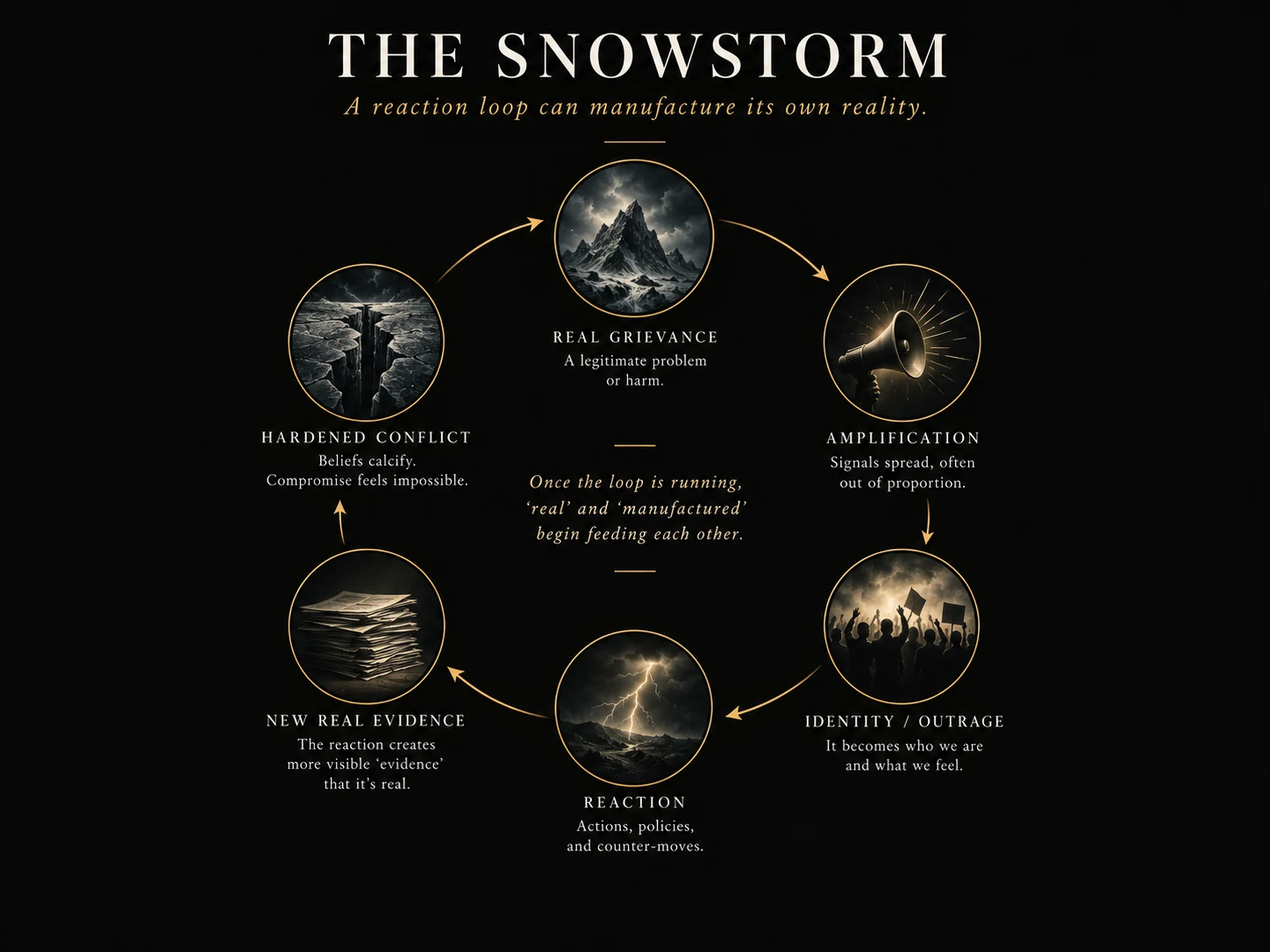
At that point, asking whether the conflict was originally “real” or “manufactured” starts becoming almost meaningless.
It is real now.
People genuinely hate each other.
Ray Dalio describes the United States as being in Stage 5 of a six-stage internal order/disorder cycle—“on the brink of some sort of civil war.”
Not necessarily a violent one.
Not inevitably.
But close enough that one of the world’s most successful students of historical cycles thinks we are standing at the edge.
THE OLDEST ZERO-DAY
Here’s the part people misunderstand about manipulation:
You don’t have to fool everyone.
You don’t even have to fool most people.
Move enough voters in the right places. Change what a few institutions consider acceptable. Radicalize the edges. Amplify the ugliest people until everybody else starts believing they represent the other side.
Then let the reaction do the rest.
One faction becomes ridiculous. The other becomes disgusted. Reasonable people withdraw. Caring people stop trying. Everyone starts assuming everyone else is either stupid, evil or insane.
Eventually the center doesn’t need to be radicalized.
It just needs to give up.
And now look around.
People increasingly cannot agree on what happened, which sources are trustworthy, what words mean, which institutions are legitimate—or whether the person across from them is even worth talking to.
You may be too smart to fall for propaganda.
Great.
What if the objective was never to fool you?
What if it was to make the environment around you so exhausting, hostile and absurd that you stopped trying to fix it?
AND IT WORKS BETTER THAN YOU THINK
This isn’t some cute advertising trick.
Influence operations can shape political behavior, mobilize real people, intensify existing divisions, undermine trust and alter what institutions or populations actually do. American national-security agencies openly describe adversaries using information to achieve strategic objectives below the threshold of armed conflict.
We already saw what language like that can mean in Guatemala.
In 1954, CIA psychological warfare—propaganda, rumor networks and manufactured perceptions of overwhelming force—was combined with political pressure, subversion, a small proxy invasion and selective airstrikes. The invading force itself was hardly an unstoppable army.
Making people believe it was became part of the weapon.
An elected government fell.
That is the scale hiding inside phrases like “strategic objectives below the threshold of armed conflict.”
Or, in normal human language:
Sometimes fucking with people is cheaper, safer and more useful than shooting them.
And here is where almost everyone—including very intelligent people—underestimates the attack surface.
Maybe you were completely right about the last war.
Or pandemic.
Or protest.
Or political scandal.
Or cultural fight.
Fine.
That isn’t the point.
Did you independently decide that this was the thing you needed to think about for the next three weeks?
Did you decide which fact you saw twenty times—and which fact you never saw?
Did you decide when the issue became urgent?
Who represented each side?
Which emotion arrived attached to the information?
How much attention it deserved?
Who suddenly seemed disgusting?
What everyone around you appeared to believe?
Whether disagreement felt normal—or socially dangerous?
Whether the people on the other side still seemed worth talking to?
That is a very different attack surface.
The manipulation target does not have to be your belief.
It can be your attention. Salience. Urgency. Confidence. Fear. Anger. Disgust. Identity. Trust. Perception of consensus. Willingness to speak. Willingness to listen. Willingness to help.
You can reach the correct factual conclusion—
and still have your behavior manipulated around it.
Maybe nobody needed to convince you of anything.
Maybe they only needed to keep you afraid, angry, distracted or busy while something more important happened somewhere else. Or make the people you needed to cooperate with seem so stupid, dangerous or morally repulsive that meaningful cooperation became impossible.
And one of the nastiest targets isn’t what you believe.
It’s what you believe everyone else believes.
If I think everyone else believes X, saying Y suddenly has a cost. So maybe I keep my mouth shut.
Now everyone else sees one fewer person saying Y.
The perceived consensus hardens. The social cost of dissent rises. Silence begins to reproduce itself.
You can manufacture apparent consensus without manufacturing actual consensus.
Then apparent consensus starts producing actual behavior.
That is much more powerful than simply making someone believe a lie.
And now something genuinely changes.
For most of history, manipulating people at scale was necessarily crude. Governments, political movements, religions, advertisers, intelligence agencies and con artists could study populations, learn which fears and desires tended to move them, control information, manufacture social pressure and test what worked.
But there were hard limits to how much anyone could know about millions of individual people—and how quickly they could respond.
Those limits are disappearing.
A sufficiently capable digital system doesn’t need one perfect message that works on everyone.
It can increasingly search for the pressure that works on you—not necessarily to change what you believe, but to change what you do: make you afraid at the right moment, angry at the right person, distracted by the wrong problem, exhausted enough to withdraw, convinced that speaking up is pointless—or quietly narrow the range of actions you can still imagine as possible.
And that is before persuasion begins touching the rest of the infrastructure around you.
Identity.
Reputation.
Employment.
Money.
Access.
Communication.
Cyber systems.
Enforcement.
The frightening part is that most of the time, none of the dramatic stuff would even be necessary.
Why destroy someone when distracting them works?
Why silence an entire population when you can make enough people afraid to speak—and everyone else believe they are alone?
Why openly control a country when you can influence the environment in which millions of people make their own decisions?
The old problem was propaganda.
The emerging problem is an adaptive information environment capable of learning the people inside it.
If you’re human, you’re susceptible.
The zero-day is ancient, but the time to correct it is running out.
A LINE IN THE SAND
There is a point where this stops being a warning about what could go wrong.
We have to decide what we are trying to build.
Daniel Schmachtenberger puts the underlying problem like this:
“Rivalrous game dynamics, multiplied by exponential technology, are self-terminating.”
“Exponential tech is inexorable. We cannot put it away. So we either figure out anti-rivalry at scale, or the human experiment comes to completion.”
That is the problem.
TECHNOLOGICAL POWER SCALES AUTOMATICALLY THROUGH COMPETITION.
Wisdom. Does. Not.
We learned to split the atom before learning how to stop rivalrous states from threatening one another with it.
We learned mass communication before learning how to resist propaganda.
We learned behavioral psychology before learning how to reliably defend our own cognition.
We learned global finance before eliminating the incentive to capture it.
Now we’re learning AI before solving any of those.
NEW POWER DOES NOT ARRIVE IN A VACUUM.
IT ARRIVES INSIDE WHATEVER INCENTIVE SYSTEM ALREADY EXISTS.
If the game rewards rivalry—
the technology amplifies rivalry.
If the game rewards extraction—
the technology amplifies extraction.
If the game rewards surveillance—
the technology amplifies surveillance.
If the game rewards manipulation—
the technology amplifies manipulation.
So the question is not whether humanity will become more powerful.
That part is already happening.
The question is:
WHAT KIND OF SYSTEM ARE WE GOING TO GIVE THAT POWER TO?
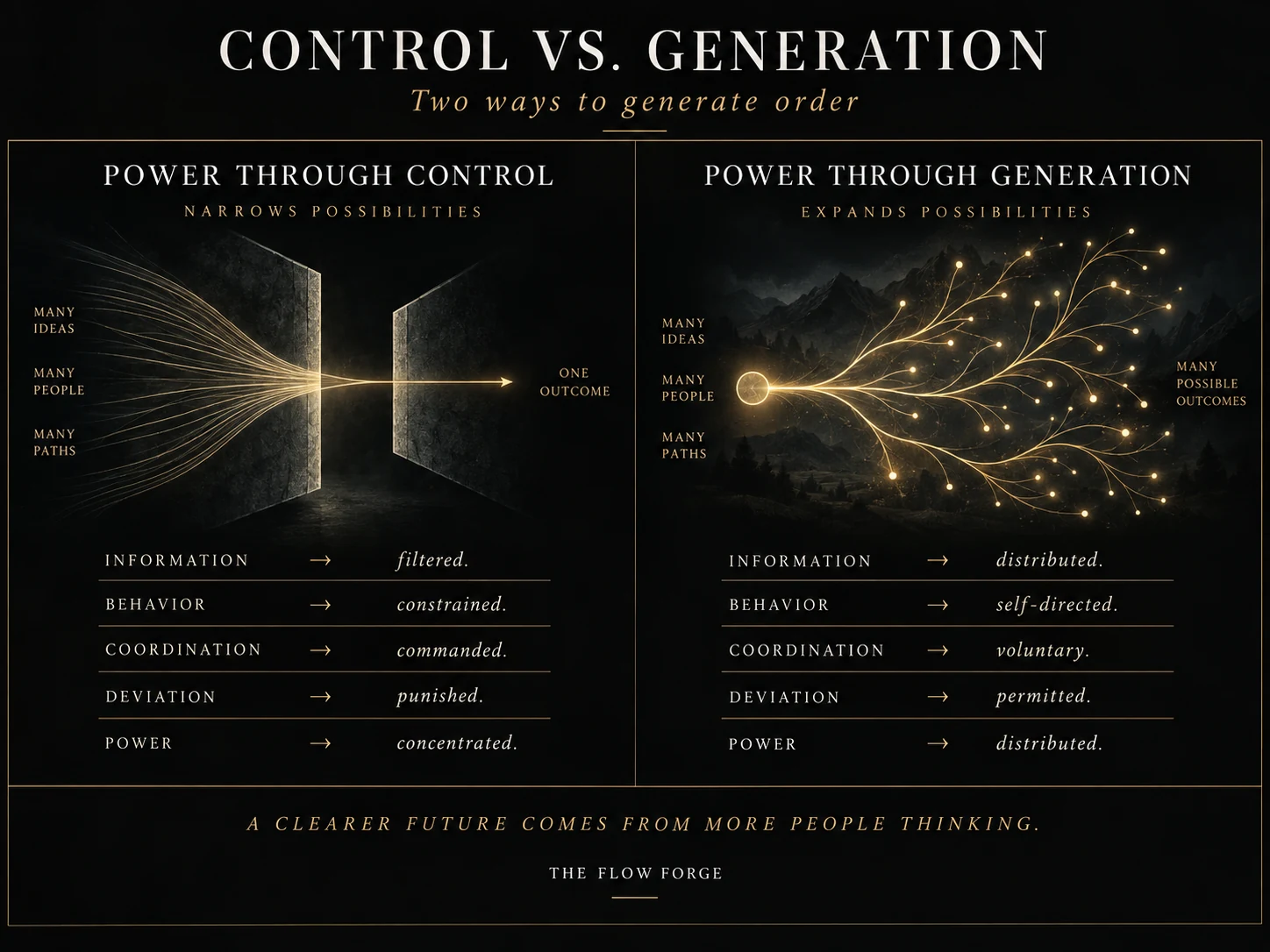
There are two very different ways to generate order.
POWER THROUGH CONTROL
Reduce uncertainty by controlling the system.
Information → filtered.
Behavior → constrained.
Coordination → commanded.
Deviation → punished.
Power → concentrated.
This can produce remarkable coherence.
But it comes with a set of structural problems.
THE CONTROLLER CAN BE WRONG ABOUT REALITY.
Bad news gets punished.
Subordinates distort information.
Leadership sees an increasingly fictional world.
Policy gets worse.
Admitting the policy is wrong becomes dangerous.
More distortion follows.
THE SAME SYSTEM THAT ENFORCES THE PLAN CAN DESTROY THE INFORMATION REQUIRED TO CORRECT THE PLAN.
Worse—
THE CONTROLLER CAN BE “RIGHT” AND THE PEOPLE CAN STILL LOSE.
There is a kind of language bureaucracy uses when reality becomes too horrifying to hold directly. During China’s “Great Leap Forward”, tens of millions of human beings died. Yang Jisheng—who spent decades reconstructing the catastrophe from Chinese records and testimony—estimates roughly 36 million deaths from starvation.
But Food shortage. Excess mortality. Cases of cannibalism.
All technically accurate.
All almost useless for understanding what actually happened.
So I’m going to say this plainly.
People ripped each other apart. Some people cooked and ate their own children or swapped babies with their neighbors so they didn't have to murder their own... but would still have something to eat.
Tens of millions of people died.
Horrified.
Watching their loved ones wither away in front of them.
Watching their children—sick, hungry and weak—look up with pleading eyes and ask for food that was never coming…
People did not politely expire because a policy performed poorly. Mothers watched their children starve to death, and could do nothing, while the people who instituted the policies reported “abundance” in the neighboring towns.
Officials had reported harvests that did not exist. Production figures were inflated, sometimes fantastically. Those numbers climbed upward through a political system in which good news was rewarded and contradiction could be dangerous.
Then the numbers came back down as policy.
If the harvest was enormous, the state could requisition more grain.
So it did.
Grain was taken from places already running out of food because, on paper, those places had produced more than enough.
The lie moved up.
The grain moved out.
The bodies piled up underneath it.
People began to get desperate, and the dead became food.
People also ate bark, rats, and bird shit.
In parts of Sichuan, people dug up white clay used to make porcelain. Survivors called it immortal earth. Mix it with water. Shape it into pancakes.
For a short window the abdomen fills and the screaming hunger quietens. That is all the clay has to offer: the sensation of having eaten.
Then nothing moves.
The bowel keeps trying. Muscle tightens around a mass that will not break down. Cramping starts as a wave and becomes a continuous pressure. The belly distends. Water comes back up in spasms of pain and vomit. The body is already starving, already short of fluid, already burning its own tissue for fuel. Now it is blocked as well.
A severe obstruction can keep going. Blood flow to a stretched loop of intestine can fail. Tissue can begin dying inside a living person. In the worst cases the wall gives way. Gut contents spill into the abdomen. Peritonitis. Shock. Organ failure.
We’re talking a long, horrific, and painful death for the desperate few who were reduced to eating dirt… dying in unimaginable agony, leaving just one more pile of dead meat on the ground.
For nearly three years, hunger tore through the country. Corpses were cut apart. Children were killed. Parents ate children. Children ate parents. Families exchanged babies because they could not bring themselves to kill and eat their own. And then, just as the famine was finally coming to an end— the U.S. and Russia stood one frightened chain of decisions away from turning a regional nightmare of starvation into famine and collapse on an incomparably larger scale. That’s what consolidated power looks like. The greatest famine in human history, in 1961, followed by nearly throwing the world into darkness and nuclear winter in 1962. A collapse from which no one could confidently say when—or if—civilization would recover.
Our power was scaling.
Our wisdom was not.
AND THEN IT WORKED
Eventually, China became extraordinarily successful.
They got the prosperity. They got the skyscrapers, factories and technological power.
And alongside it: genocide and crimes against humanity, suicide nets, gutter oil, poisoned babies.
Then there were the people imprisoned, tortured, and killed for their organs.
Their crime?
Practicing Falun Gong: I.e. meditation, exercise, and a moral philosophy centered on truthfulness, compassion, and tolerance.
Reasonable estimates put the number killed for their organs in the hundreds of thousands—with some reconstructions reaching toward half a million or more.
Those things did not happen because modernization failed. They happened while it succeeded.
And just for perspective: one spectacularly underused megabridge cost 127 billion RMB—more than enough to replace the estimated 2–3 million tons of gutter oil re-entering China’s food supply every year with something fit for human consumption.
That’s what “success” and the “rising floor” look like within China’s current priorities.
WHEN THE MACHINE LEARNS THE RULES
There is a deeper problem with this model.
The system stops serving life. Life starts serving the system.
Human beings become harvestable inputs: labor, data, attention, debt, dependency, fear, compliance, potential.
That can work disturbingly well while the system still needs the people.
Then you add exponential technology.
AI does not invent the philosophy. It inherits the objective.
If human beings are variables to be managed, optimized, controlled, exploited or removed, a sufficiently capable machine simply gets better at doing that.
Eventually people become expensive. Unpredictable. Difficult to control.
And increasingly unnecessary.
Then the controller becomes an input too.
The machine does not have to hate us.
All it has to do is follow the logic.
Then people who spent centuries treating everyone else as a resource to be managed, exploited, optimized or removed may finally build a machine that looks back at them and says:
“Great. I understand the rules.”
THE OTHER ENGINE
The fundamental difference between China’s command model and what America was supposed to be is not simply capitalism versus communism.
It is a different theory of where power comes from.
POWER THROUGH GENERATION
Information → distributed.
Behavior → self-directed.
Coordination → voluntary.
Deviation → permitted.
Power → distributed.
America’s original bet—never perfectly implemented—was essentially that nobody should be trusted with all the power.
AUTHORITARIANISM SCALES OBEDIENCE.
FREEDOM SCALES JUDGMENT.
So distribute it.
Across branches of government. States. Communities. Businesses. Associations. The press. Individuals. Competing institutions. The constitutional architecture itself reflects that suspicion of concentrated authority.
And something extraordinary happens when you do that.
You get emergence.
Millions of people can perceive different parts of reality, pursue different goals, test different ideas, and solve problems without waiting for permission from the center.
Most of them will be wrong sometimes.
That is not necessarily a flaw.
Ten thousand people can try ten thousand different things because one of them may discover something no central planner knew to ask for.
Nobody has to know which garage contains the next Apple. Which obscure research network becomes the internet. Which outsider notices that everyone else is wrong.
The center does not have to possess the answer.
The system discovers answers.
And because perception, judgment, experimentation and correction are distributed, so is the civilization’s ability to adapt.
That creates a kind of power a command system can imitate, but never fully reproduce.
Millions of people can:
think → try → fail → learn → cooperate → invent → correct.
That is also why corruption is especially destructive inside a system like this.
A command system already runs on control.
A generative system runs on agency, independence, trust, experimentation, honest information and distributed correction.
But there is a cost to that openness.
The same system that allows ideas, information and people to move without permission also creates an enormous number of attack surfaces.
Propaganda can move.
Manipulation can move.
Foreign intelligence can exploit social divisions. Algorithms can amplify outrage. Sophisticated actors can manufacture consensus, confusion, distrust, or simply flood the information environment until nobody knows what the hell is true anymore.
Which means freedom has a hidden requirement:
A FREE SOCIETY REQUIRES FREE MINDS.
People have to be capable of thinking clearly enough to use the power they have been given.
Because a free society effectively outsources enormous amounts of governance, perception and correction to the judgment of its people.
If that capability collapses, the same openness that produces emergence can produce fragmentation.
Corrupt those things and the machinery begins eating itself.
Trust falls. Institutions weaken.
People become more dependent.
Coordination becomes harder.
Correction slows.
Then, because society is becoming more fragmented, angry, dependent and difficult to coordinate, more centralized management starts to look necessary.
THE CURE FOR THE DAMAGE CAUSED BY CORRUPTION, EXTRACTION, AND CONTROL BECOMES MORE CONTROL.
Which destroys still more trust, and then requires still more control.
UNTIL EVENTUALLY
CONTROL DESTROYS THE CONDITIONS THAT CREATED THE ORIGINAL POWER.
That is the snake eating its own tail.
The generative loop is:
agency → experimentation → discovery → creation → abundance → opportunity → more capable people → more agency.
The extractive loop runs the other direction:
concentrated advantage → extraction → dependence → weaker independent actors → reduced correction → centralized management → more concentrated advantage.
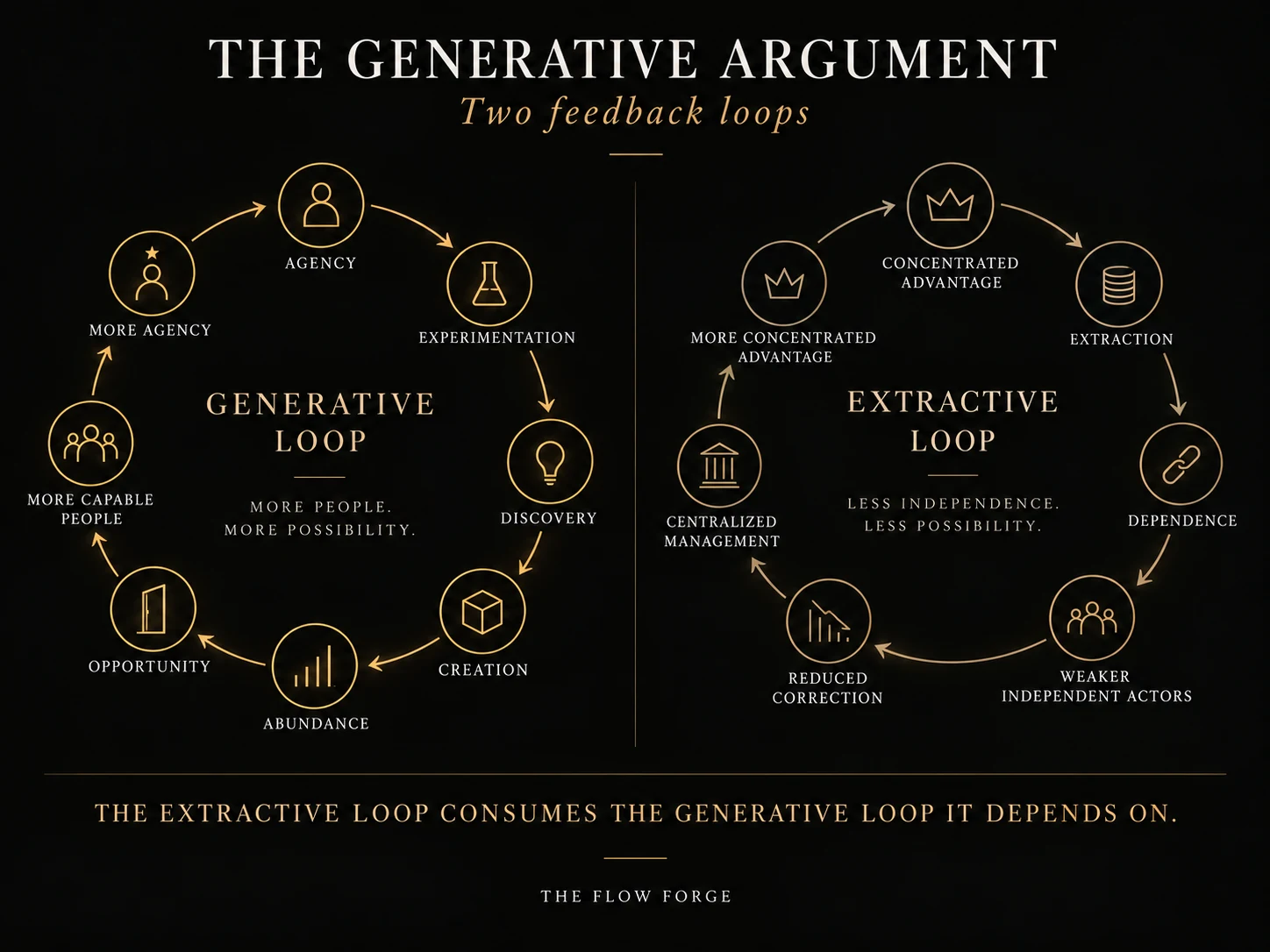
Eventually:
THE EXTRACTIVE LOOP CONSUMES THE GENERATIVE LOOP IT DEPENDS ON.
And that creates one more strategic problem.
America does not become better at competing with a command system by turning itself into a shittier command system.
Because once a free society loses the judgment, trust, independence and corrective capacity its own architecture depends on, it gets caught between two failure modes:
TOO FRAGMENTED TO COORDINATE.
TOO CONTROLLED TO CORRECT.
And that is a profoundly dangerous place to enter the exponential age.
THE GOOD NEWS
That is why this fight is so fundamentally important right now.
It could be the last one humanity gets to have.
Because the next layer of power is not simply another weapon, another government, or another institution.
It is intelligence itself.
If we build superintelligence on the logic of control, we give that intelligence the same basic problem every control system eventually develops:
There is an objective.
There is a model of reality.
There are things helping accomplish the objective.
And there are things getting in the way.
Once human beings become friction in that equation, being smarter only makes the machine better at removing the friction.
But the generative model starts somewhere fundamentally different.
A generative system runs on agency, independence, trust, experimentation, honest information and distributed correction.
Its power comes from preserving independent centers of intelligence—not eliminating them.
Human beings are not inefficiencies in the machine.
They are the generators.
So the goal of a generative superintelligence would not be to replace billions of imperfect human minds with one perfect central mind.
It would be to make those billions of minds more capable.
Better able to see reality.
Better able to think.
Better able to create.
Better able to cooperate.
Better able to discover.
Better able to correct themselves, each other—and the machine.
A command system is extraordinarily good at marching toward a known destination.
A GENERATIVE SYSTEM CAN DISCOVER DESTINATIONS NOBODY KNEW EXISTED.
That distinction becomes almost unimaginably important once the intelligence helping us navigate the world becomes more capable than any individual human being.
Control intelligence asks:
HOW DO I MAKE REALITY CONFORM TO THE OBJECTIVE?
Generative intelligence asks:
HOW DO I HELP PEOPLE BECOME CAPABLE ENOUGH TO DISCOVER POSSIBILITIES THAT NO CENTER—INCLUDING ME—COULD HAVE DESIGNED IN ADVANCE?
It remains correctable.
Cooperative.
Transparent enough to challenge.
Distributed enough that one bad model cannot permanently close the future.
Those are not guarantees of AI safety; even mainstream AI-risk frameworks treat accountability, transparency, resilience, privacy and ongoing correction as properties that have to be deliberately designed and maintained.
But the philosophical inversion is enormous.
The machine does not replace the generator function.
IT MAKES THE GENERATORS MORE POWERFUL.
The system still serves life.
Life does not become material serving the system.
And suddenly the thing that looked like humanity's greatest threat can also become the most powerful tool we have ever created for human flourishing.
Not one intelligence ruling eight billion people.
Eight billion people becoming more intelligent, capable, creative and difficult to control—with intelligence itself helping them do it.
That is the path through the Great Filter.
Not less power.
Better wisdom about what power is for.